

The Pomodoro technique is one of the simplest and smartest time-management methods in today’s workplace, built on splitting work hours into short focus blocks with regular breaks—helping employees protect mental energy and reduce distraction.
Pomodoro time blocks have become especially useful as work speeds up and daily tasks multiply, making practical productivity methods essential without exhausting the team.
In this article, we explain how the Pomodoro technique can make a real difference in employee performance in office environments, highlighting simple office tools that make it easy and effective to apply—and turning time management from a daily burden into an organized workflow that improves focus and quality of output.
What is the Pomodoro technique?
The Pomodoro technique is a time-management approach that divides work into short focus sessions—often 25 minutes—followed by a short 5-minute break.
After completing several consecutive sessions, you take a longer break. This method helps you tackle large tasks gradually and in an organized way, and prevents the fatigue that comes from nonstop work for long stretches.
The core idea behind the Pomodoro technique is that the human brain works more efficiently when it knows focus is required for a clear, limited period, followed by dedicated rest—making commitment easier and consistency higher.
The idea of splitting time into work sessions and breaks
Instead of working for long hours without interruption, the Pomodoro technique organizes time into clear units: a focused work session, then a short break.
During the work session, you stop any distractions and focus on one task only, while the break is used to restore mental and physical energy away from task pressure.
This structure helps to:
-
Maintain a steady level of focus.
-
Reduce mental distraction and fatigue.
-
Make progress measurable and easy to track.
Why does this technique work well for office work?
The Pomodoro technique works especially well in office environments because it matches the nature of daily tasks such as computer work, report writing, email follow-ups, and analytical meetings. These tasks require mental focus more than physical effort, which the technique supports effectively.
Office settings are also often full of interruptions—notifications, coworkers, and multitasking. Here, the Pomodoro technique helps employees organize their time clearly and increase productivity without needing longer working hours, making it a practical, easy-to-apply option across different companies and offices.
Also read: Wholesale Office Supplies: When Do You Need a Supplier Contract?
Benefits of the Pomodoro technique in the workplace
Applying the Pomodoro technique at work delivers a set of practical benefits that directly improve employee performance and the quality of task completion—especially in office jobs that require sustained mental focus.
1- Better focus and less distraction
Working within fixed time sessions makes the employee more committed to focusing on one task without jumping between multiple tasks. This method reduces mental interruptions and limits distraction caused by notifications or side work, raising the quality of focus during working time.
2- Higher task completion efficiency
Breaking work into short periods makes large tasks less complex and easier to execute. With each completed session, the employee feels progress and achievement, which boosts motivation and helps finish tasks in less time and with higher efficiency.
3- Reduced mental fatigue
Regular short breaks give the brain a chance to recharge and reduce the stress caused by continuous focus for long periods. This balance between work and rest helps employees stay mentally active throughout the day without feeling drained.
4- Better structure for the workday
The Pomodoro technique creates a clear framework for time management, turning the workday into easy-to-plan units. This organization helps employees prioritize, stick to a daily schedule, and achieve a better balance across different tasks.

Simple office tools to apply the Pomodoro technique
The Pomodoro technique doesn’t require complex tools or advanced technology to succeed. You can rely on a set of simple office tools that help employees stick to focus sessions and manage time effectively.
1- A desk timer (analog) or digital timer
A timer is the core tool for applying the Pomodoro technique, used to set the exact length of the work session and break time. Whether it’s a traditional desk timer or a digital app, it helps employees commit without constantly watching the clock.
2- A notebook to break down tasks
Using a notebook allows employees to write daily tasks and split them into short, doable sessions. This makes work clearer, helps track progress, and creates a sense of achievement after each session.
3- Clear pens and writing tools
Good writing tools play an important role in organizing ideas and capturing notes quickly during work sessions. Having comfortable, clear pens and writing tools makes planning easier without pulling attention away.
4- A desk clock or alarm
A desk clock or alarm can be a practical alternative to a digital timer—especially in workplaces that prefer limiting phone use. Keeping it in view strengthens time-awareness and encourages commitment to set work sessions.
5- Noise-canceling headphones
In open-plan offices, noise-canceling headphones help reduce surrounding sounds, improving focus during Pomodoro sessions. They are an effective tool for maintaining a quiet work environment that supports productivity. To equip your team, explore LAWAZEM’s office supplies and stationery items catalog.
Also read: Office Supplies in Al Khobar: Bulk Office Stationery and Supplies

How do you apply the Pomodoro technique using office tools?
Applying the Pomodoro technique becomes more effective when you combine it with the right office tools. These tools help organize work and turn the technique into an easy daily system to follow.
1- Prepare a task list before you start
Before starting any work session, it’s recommended to write a clear list of required tasks using a notebook or task sheet. Splitting work in advance helps choose the right task for each session and prevents wasting time deciding what to do while working.
2- Set the timer for the work session
After selecting the task, set the timer or desk clock to the chosen session length. During this period, focus fully on one task only without interruption, which builds discipline and improves the quality of completion.
3- Track progress after each session
At the end of each session, it’s best to record what was completed or mark the finished task. This simple tracking helps evaluate daily progress and strengthens the feeling of achievement, encouraging continued momentum.
4- Organize break periods
Breaks are a core part of the Pomodoro technique and should be treated as seriously as work sessions. Use breaks to step away from the desk, do light movement, or clear your mind—so you return to the next session with more energy and focus.
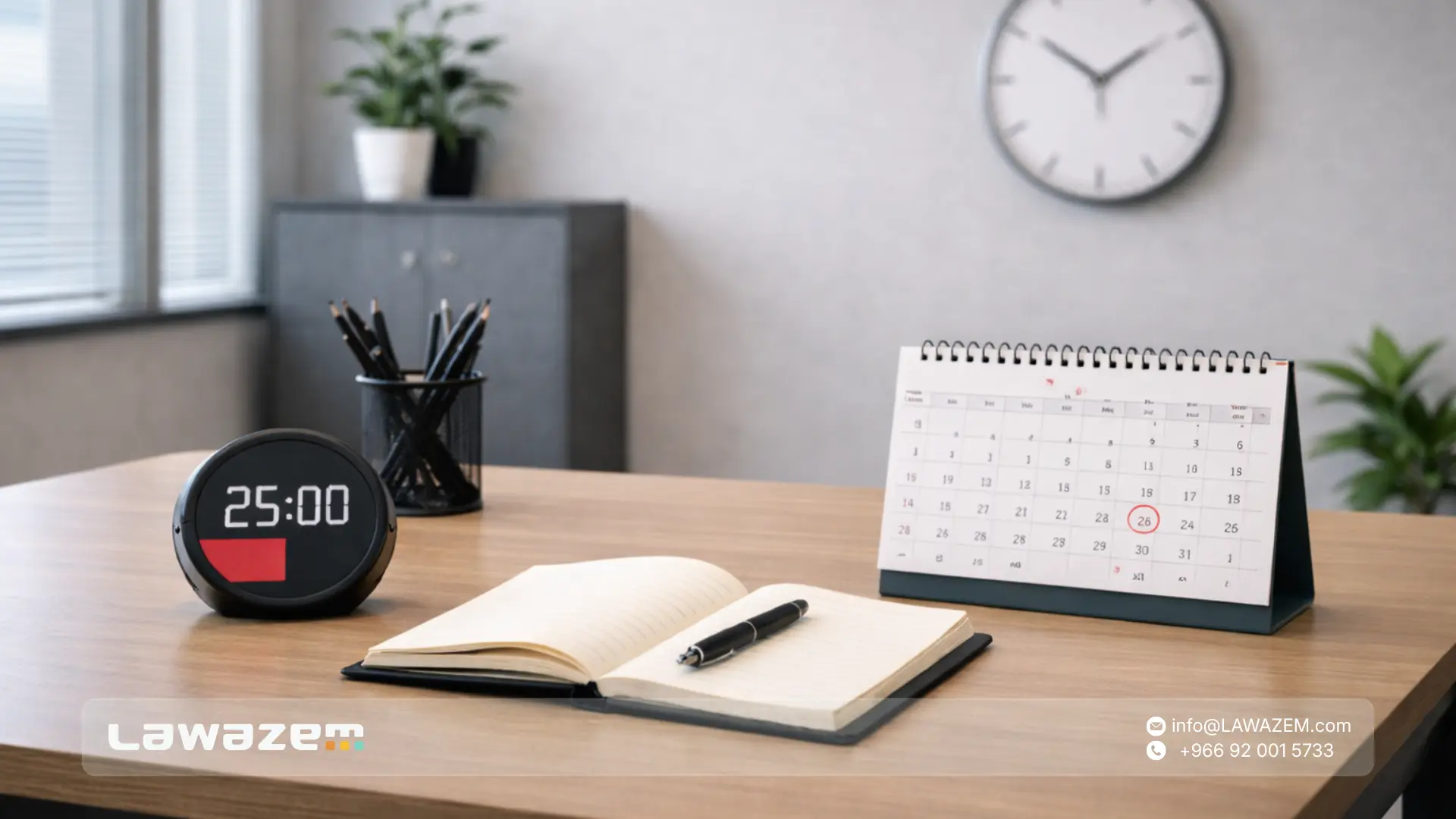
Organizing the desk space to support the Pomodoro technique
Organizing the desk space plays a key role in successfully applying the Pomodoro technique, because the surrounding environment directly affects focus levels and commitment to work sessions.
1- Reduce clutter on the desk
A desk crowded with papers and unused tools distracts attention and lowers the quality of focus. Reducing clutter helps employees enter Pomodoro sessions with a clear mind and makes the workplace calmer and more organized.
2- Keep only the necessary tools within reach
Keeping only essential tools on the desk surface—such as a notebook, a timer, and writing tools—makes them easy to access without interrupting the work session. This setup supports discipline and reduces unnecessary movement during focus.
3- The impact of visual organization on session commitment
Good visual organization—like keeping tools arranged in a consistent, clear way—reinforces a sense of control over time and tasks. This feeling supports commitment to Pomodoro sessions and makes transitions between work and breaks smoother.
Also Read: Best Office Supplies Website in Saudi Arabia: How to Choose the Right Platform?
Common mistakes when applying the Pomodoro technique
Despite how simple the Pomodoro technique is, some common mistakes can reduce its effectiveness if you don’t watch out for them.
1- Ignoring break periods
Breaks are a key part of the technique. Skipping them leads to mental fatigue and loss of focus over time, weakening the results.
2- Using unsuitable tools
Breaks are a key part of the technique. Skipping them leads to mental fatigue and loss of focus over time, weakening the results.
3- Trying to complete large tasks without splitting them
Trying to execute huge tasks in a single session goes against Pomodoro philosophy. Breaking tasks into smaller parts is what makes the technique effective and realistic to apply.
4- Too many interruptions during the session
Allowing repeated interruptions—whether from notifications or coworkers—breaks the focus streak. Reducing interruptions as much as possible is essential to get the full value of Pomodoro sessions.
When is the Pomodoro technique the best choice?
Not every time-management method fits every type of work, but the Pomodoro technique is a practical, effective option in many office scenarios—especially when focus and organization are essential to getting things done.
1- Work that requires high concentration
The Pomodoro technique is highly suitable for tasks that need sustained mental focus, such as analysis, report preparation, or data review. Dividing time into short sessions helps maintain a high level of focus without overloading the brain.
2- Repetitive administrative tasks
In administrative work that repeats daily—like data entry or email follow-ups—the Pomodoro technique helps organize time and prevents hours from being consumed without a sense of achievement.
3- Daily office work
Daily office routines often include multiple similar tasks. Applying the Pomodoro technique makes the workday more structured and helps employees distribute effort more evenly throughout the day.
4- Individual work within large teams
When working within large teams, an employee may need individual focus periods away from constant interaction. The Pomodoro technique provides a clear framework for these periods, improving productivity without hurting team collaboration.

The role of LAWAZEM office tools in boosting daily productivity
In today’s workplace in Saudi Arabia, improving productivity is no longer about complex systems or more tools—it’s about how easily teams can access the right office tools and use them in an organized way.
This is where LAWAZEM’s platform stands out, offering companies and offices a complete range of essential office tools with an organized buying experience that helps teams adopt effective work methods like the Pomodoro technique without complexity.
By providing practical office tools and organizing ordering and supply, LAWAZEM helps Saudi companies improve time management, reduce waste, and support daily employee productivity in a simple approach that can work in any office. If you manage procurement, create a LAWAZEM business account to streamline approvals and recurring office stationery orders.
Why don’t you need complex tools to raise productivity?
Higher productivity isn’t always tied to advanced tools or expensive tech—it depends on clarity of the system and ease of application. Basic office tools such as timers, planning notebooks, and comfortable writing tools help employees focus on the task itself instead of getting distracted by the tools.
How do simple tools help you stick to the system?
Simple tools reduce psychological and organizational friction, making it easier to stick with methods like Pomodoro long term. When tools are clear and always available on the desk, starting a work session and following the timer becomes automatic and doesn’t require extra effort.
The link between desk organization and time management
Good desk organization directly improves time management. Keeping only the necessary tools and arranging them logically reduces unnecessary interruptions and makes it easier to move between tasks and work sessions—supporting consistency and daily productivity.
Tips for integrating the Pomodoro technique into work culture
The success of the Pomodoro technique doesn’t depend only on individual commitment, but on how well it integrates into daily work culture in a flexible, practical way that supports team productivity.
1- Encourage teams to work in focused sessions
The success of the Pomodoro technique doesn’t depend only on individual commitment, but on how well it integrates into daily work culture in a flexible, practical way that supports team productivity.
2- Use the technique in short meetings
The Pomodoro technique can also be applied to short meetings by setting a clear time limit for discussion and decision-making. This structure helps reduce unnecessary overruns and makes meetings more efficient and focused.
3- Measure results and improve application
It’s important to monitor the results of applying the technique—both in speed of task completion and work quality. Reviewing these results helps adjust session length or the application style to match the team and the work.
Frequently asked questions about the Pomodoro technique
1- Is the Pomodoro technique suitable for all employees?
The Pomodoro technique fits most office work, but its effectiveness varies from person to person. Each employee can adjust it to match their tasks and working style.
2- What is the ideal number of sessions per day?
There is no fixed number, but typically 6 to 10 sessions per day are enough to complete core tasks without exhaustion.
3- Can the session length be adjusted?
There is no fixed number, but typically 6 to 10 sessions per day are enough to complete core tasks without exhaustion.
4- What are the best office tools to apply the technique?
The best tools are a timer or desk clock, a notebook for breaking down tasks, comfortable writing tools, and noise-canceling headphones to support focus in the workplace—so your team can apply the Pomodoro technique consistently. Contact LAWAZEM to help you equip your office with the right tools and set up a smoother supply plan.